Plan your trip
Money
How to pay for things in Zimbabwe, and why small US dollar notes are your best friend.
Last updated October 2026
US dollars are the everyday currency for visitors
Lodges, tours, national park fees and most restaurants in tourist areas price in US dollars, and paying in cash US dollars is usually simplest. Zimbabwe also has its own currency, the Zimbabwe Gold (ZiG), introduced in 2024. It is legal tender, and you may receive ZiG as change, but most visitors rarely need it.
Bring small, clean notes
- Carry plenty of $1, $5, $10 and $20 notes. Change for $50 and $100 notes is often hard to find.
- Torn, marked or very old notes may be refused, so bring newer notes in good condition.
- Keep exact cash for any visa you buy on arrival.
Cards and cash machines
Visa and Mastercard are accepted at many hotels, lodges, larger supermarkets and tour operators, but smaller shops, markets and fuel stations may take cash only, and card payments can fail when connections are down. Cash machines are not always reliable for foreign cards and may run out of cash, so do not depend on them. Bring the cash you expect to need and a card as back-up.
Mobile money
Many people in Zimbabwe pay by mobile money such as EcoCash. It needs a local SIM and account, so it is usually not practical for short visits.
Changing money
Change money only at banks or licensed bureaux, never on the street. Keep cash spread between a few places and avoid showing large amounts in public.
Tipping
Tipping in US dollars is common for guides, drivers, lodge staff and in restaurants. Lodges often have a shared tip box for staff who work behind the scenes.
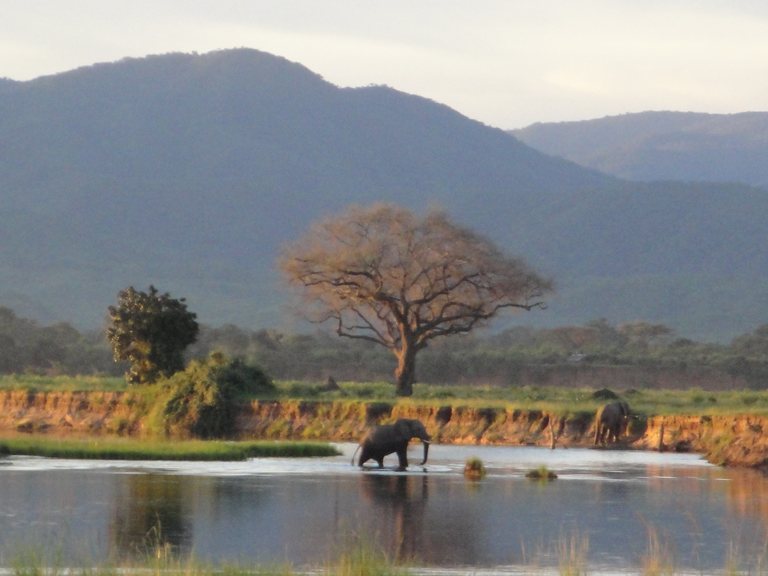
Photos: Victoria Falls · Photo: lumoplank · CC0 1.0Eastern Highlands · Photo: Teddy Matendawafa · CC BY-SA 4.0Mana Pools · Photo: Babakathy · CC0 1.0Lake Kariba · Photo: SuSanA Secretariat · CC BY 2.0Gonarezhou · Photo: Babakathy · CC0 1.0